March 27, 2025
THE BIG PICTURE ‘But Never Enough Attorneys To Help Everybody…’
BY Montague Reporter
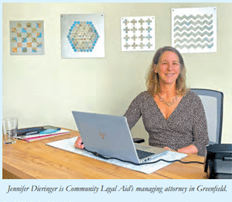 GREENFIELD – For the last three decades, the main civil legal aid organization serving central and western Massachusetts has not staffed an office in Franklin County. Attorneys with Community Legal Aid (CLA) supporting tenants facing eviction, workers in dispute with their employers, and low-income people in general trying to navigate family law, seal criminal records, or access benefits did so on day trips from the nearest office in Northampton.
That changed this winter, when CLA opened a very swanky new office at 14 Hope Street in Greenfield, straight across the street from the district courthouse.
The building, long the headquarters of the Greenfield Recorder, was purchased in 2022 by real estate developer Mark Zaccheo of Olive Street Development, who rented the front section to the newspaper, set up an office for himself, and extensively renovated a 3,263-square-foot rear space for new commercial rental.
The Reporter caught up with CLA managing attorney Jennifer Dieringer last week to discuss the move, as well as CLA’s areas of practice. The office felt sunny, open, and modern, its sleekly painted ductwork, confident wallpaper patterns, high wooden ceilings, and large thriving plants a sharp contrast to the ways bureaucracy and civil litigation can suffuse and petrify the experience of poverty in America.
This transcript of our interview has been abridged, reordered, and edited for clarity.
MR: I always say this when I start taping, but if anything’s off the record, let me know.
JD: Okay! I don’t know what kind of hard-hitting questions you’re going to ask, but I have no comment on the current federal situation.
MR: I think there could be some things that touch on its impacts…
JD: I mean, the short answer is it’s too soon to tell – we haven’t had any impacts yet. We’re bracing.
MR: This office is really striking. When did it open?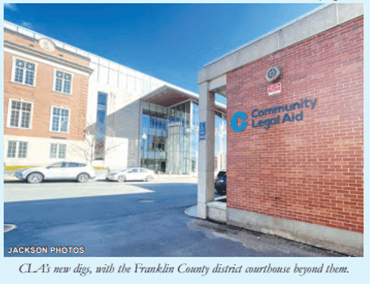
JD: We opened to our staff in November, and the ribbon-cutting was in January.
MR: You’ve had another secret office in Greenfield for a while, where you were meeting with clients on an as-needed basis – how long was that going on?
JD: Over 30 years ago, we closed down our fully-staffed office in Greenfield because of funding reasons, but we kept the space to meet with clients as we needed to.
I think we served Franklin County well, relative to the poverty population. But about two years ago we were in a strong financial position, and it was always on the wish list to reopen the Franklin County office – you know, “build it and they will come.”
MR: How long had you been looking at real estate within a block of the courthouse?
JD: For a while, though that wasn’t a concern so much as being in downtown Greenfield, where people could easily access by bus.
It was not easy! We looked at a bunch of second-floor places – all beautiful spaces, like in the brick buildings on Main Street – but they were oddly configured, or they weren’t really big enough, or the elevators didn’t always work, and we need to be accessible.
And then we saw this, and it was such a mess that it was hard to imagine. None of these walls existed, it was all just a bunch of cubicles, and there were drop ceilings that covered half of the windows, and a lot of the windows were boarded up or fogged so you couldn’t see out of them.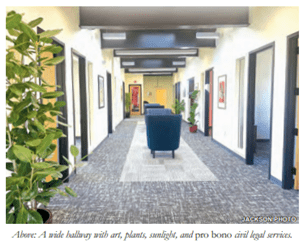
We got help from Mark’s brother David, who’s an architect, and we worked with this amazing firm out of Northampton called Workroom Design Studio, who helped us envision what it could look like.
MR: Did you manage the whole build-out and move in? What was the biggest challenge?
JD: Yes. I also managed the Berkshire office, so I had the three counties for a while, but now that we’re here full-time I gave Berkshire to somebody else and I’m just focusing on Franklin and Hampshire.
I’d never done anything like this before, and I had some help but it was quite the learning experience. I wasn’t the general contractor – Mark did that – but making sure we knew what was happening on our end was an adventure. Just trying to figure out the timing of it, because we were hiring new people and also moving people around.
We have permanent attorneys here now: a family law attorney, a fair housing attorney, a regular housing attorney, an elder attorney, and an employment attorney, and we are in the process of hiring a criminal records attorney. Slowly but surely, we’re building. And this is the miracle: only two of us don’t live in Franklin County! I split my time between here and Northampton.
MR: Do you practice yourself ?
JD: I do. I mostly manage the offices, but my background is in housing, so for example today I was in court helping out.
MR: How’d it go?
JD: It was very, very busy, a packed courthouse. A lot of tenants defaulted, which is to say that they didn’t show up, which is unfortunate because then the landlord can automatically move to eviction… it makes it a more complicated situation. We had a couple of cases settle, so it was good, we were able to help a good number of people today.
MR: In housing court, the judges are in different towns on different days?
JD: Yeah, in the Western Mass housing courts – the judges, the housing court specialists, and the clerks – all circuit through. Springfield is Monday through Friday, 9 to 5, and then the circuit courts are generally one day a week in each of the counties – for Franklin County, “eviction day,” as it’s called, is Fridays, so we were just there this morning.
We run a “Lawyer For the Day” program, so we have at least one lawyer in court on eviction day, and we’re available to help as many tenants as we possibly can. The judge comes onto the bench before the list is called and explains to everybody what the process is, and then says, “Community Legal Aid has a lawyer here today.” We do the Queen’s wave so everybody knows who we are, and then tenants can connect up with us.
The housing court specialists, the mediators, are really good at connecting folks with us, and some landlord attorneys are actually really great about it as well – attorneys whose landlords really don’t want to evict the person, but want to solve whatever problem has been presented. We are often able to work collaboratively with landlords to get tenants to stability so they can stay.
MR: And you’re working pro bono for all the clients?
JD: Community Legal Aid does not charge clients for any of our services. We are funded by the state, by the federal government, and by a variety of grants and foundations and private donations.
MR: So you’re kind of the public defenders in civil court?
JD: Yes, but the major difference is that there’s no entitlement to counsel for civil cases, whereas in criminal cases if you’re low-income you’re entitled to counsel.
We have the challenge of always having far more folks qualify for our services, meaning that they’re low-income enough, but never enough attorneys to help everybody. I think our turn-away rate is about 40% now, and housing is far and away our largest area of practice – that’s where the most need is.
Our primary funder is the state legislature, and they have been generous enough to give us increases every year over the past couple of years, and that has allowed us to help more folks. Our development department has also grown over the last decade or so…
MR: In terms of the legislative appropriation, does that come in the form of a grant that you have to periodically bid on?
JD: Yes! There’s something called MLAC, the Mass Legal Assistance Corporation – they hold the state line item for legal services, and distribute it to all the legal aid programs in the state according to poverty population.
They help us lobby for our funding. Every year there’s something called Walk to the Hill, where we go and talk to the legislature about the need for legal services. We are unbelievably fortunate in western Mass to have incredibly generous legislators who really understand the need for legal aid, partially because they’re constantly referring constituents to us for assistance.
MR: We’ve interviewed CLA in the past about the eviction moratorium – we were expecting to see an eviction “cliff” when it ended.
JD: Across the entire Commonwealth we have seen evictions are consistently up from what they were last year. I suspect there’s a number of reasons: rents continue to go up on the private market, the waits for subsidized housing are longer and longer, more folks are rent-burdened – and a lot of landlords are selling, because the house prices are so high and the inventory is so low.
We also have some speculators coming in, businesses from other places, and what they do is they buy “small-a” affordable units, units that are not subsidized but are more affordable, and they the first thing they do is they try to evict all the tenants for no cause so they can renovate and flip them and then charge exorbitant new rents. It’s been pretty devastating.
MR: You’re seeing that happen in Franklin County?
JD: Yes…. I don’t think they’re coming from inside the county.
Certainly we’re able to negotiate ample time for folks to be able to do a housing search and move out, if the landlord’s insistent on having the unit vacant…. The law in Massachusetts provides for at least a six-month stay for everybody, and up to a year for households that have either disabled or elderly folks in them. We’re good at negotiating for the time.
MR: What areas of civil litigation are you guys not involved in?
JD: Things like personal injury: that’s an area where a private bar will take it on a contingency fee basis, so there’s no payment up front.
Looking at it a different way, what we tend to focus on are the areas that have the most impact on the low-income population: family law for survivors of domestic violence; obtaining and maintaining benefits; housing law; immigration; education; criminal records law.
We’re constantly having these conversations about ‘What does the community need? What role are we not filling?’ Education and criminal records are examples of work we weren’t doing 10 years ago, and now have very vibrant units.
MR: Education – that’s like supporting families in working with public school districts?
JD: Exactly. Especially kids with disabilities and special needs, helping with IEPs, helping with families whose children are looking at disciplinary actions – we often see a connection between students who struggle with disabilities, and aren’t getting services that they need, and disciplinary actions.
MR: Then further down the pipeline, criminal records expungement – the last I remember hearing a lot about that was back during CORI reform. Where’s the front line now?
JD: There are legislators still really trying to reform CORI – Jo Comerford in particular – but Massachusetts remains a difficult state to seal and expunge criminal records. It’s not automatic, there’s a process, and it can be cumbersome. We do a lot of sealing work; we do some expungement work, for cases that fall into that somewhat narrow category.
But we also deal with the collateral consequences of having a criminal record, which is mostly that it really impacts folks’ ability to get subsidized housing and employment. We will do hearings to try to secure people housing and employment when the stumbling block is a criminal record in the process of expungement.
MR: How do you get the referrals for that – do people just know CLA is a place they can go?
JD: In Franklin County, we’re winding up a five-year DPH grant the Franklin Regional Council of Governments wrote, all about helping folks stabilize who have either substance use disorder or a criminal record. Often the two are intertwined.
Part of what we did with the money is a ton of outreach to all of the nonprofits in Franklin County and the North Quabbin, and we take direct intakes from some of those folks. On the last Wednesday of every month, from 10 a.m. to noon, we embed a lawyer at the Community Justice Support Center in downtown Greenfield, and people can just drop in.
Usually people know to come to us, because a bad thing is happening – they got an eviction notice – but with record sealing, they might not even know that they are able to seal their records, so a lot of it is community education.
MR: Do you do immigration support work in Greenfield?
JD: It’s actually another entity. We have a subsidiary called Central West Justice Center. They do immigration work, and they do not receive any federal funding. They will come up from Northampton or Springfield to help with immigration cases. We have a little conference room for attorneys visiting from other offices – the immigration folks can meet with clients in there, and it’s nicely set up for them.
We also have a collaborative with Western New England Law School, so sometimes we have clinical students here. We have nine little offices here altogether, including the student space….
The side part of the building, with the beautiful wooden exterior, is from the 1800s, which is super cool. I have to credit Mark for really bringing this building back. It’s so beautiful, and it’s so centrally located. It’s really important to have it be a vibrant space for the community.
About
Newsletter Sign-Up
Sign-up to receive Justice Matters, Community Legal Aid’s monthly newsletter!